Founded to Innovate, Built to Lead since 2002
Westminster International University in Tashkent was established in 2002 with a clear purpose to introduce internationally benchmarked higher education to Uzbekistan and to educate people capable of shaping a rapidly changing society. From day one WIUT was conceived not merely as a teaching institution, as a platform for innovation, critical thinking, and global engagement. Like many leading universities around the globe, WIUT’s story is defined not by its age but by the impact it has created in a relatively short period of time.
Building the Foundations of an International University
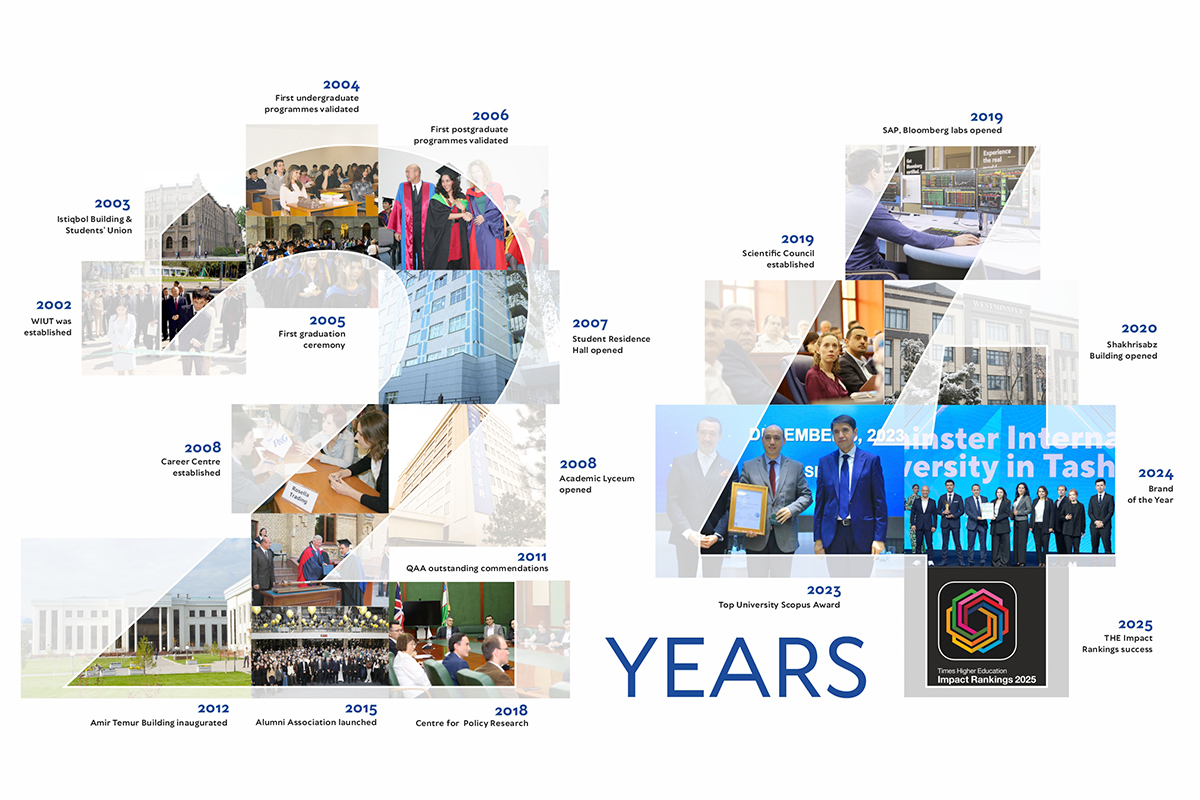
Early years were focused on creating a strong academic and institutional base. In 2003, the University established its home in the renovated Istiqbol Building, alongside the creation of the Students’ Union, embedding student voice and leadership into university life.
A defining milestone followed in 2004, when first undergraduate programmes were validated by the University of Westminster (UK). This validation anchored WIUT firmly within the UK higher education system and ensured that academic standards, learning outcomes, and assessment practices met internationally recognised benchmarks.
The University celebrated its first graduation ceremony in 2005, marking the beginning of a growing alumni community that today contributes to business, government, civil society, and innovation ecosystems in Uzbekistan and abroad. Postgraduate education followed in 2006, expanding academic depth and research capacity.
Student Experience, Quality, and Infrastructure
As the University grew, investment in student experience remained central. The opening of the first Student Residence Hall in 2007, followed by the establishment of the Academic Lyceum and Career Centre in 2008, reflected a holistic approach to education combining academic excellence with employability, wellbeing, and early talent development.
In 2011, this commitment to quality was internationally recognised when the UK Quality Assurance Agency (QAA) awarded outstanding commendations to both the University of Westminster and WIUT. The following year, the inauguration of the Amir Temur Building, together with a modern Sports Hall and Learning Resource Centre, significantly expanded WIUT’s learning and research infrastructure.
From Teaching Excellence to Research and Innovation
By the mid-2010s, WIUT had entered a new phase of institutional maturity. The launch of the Alumni Association in 2015 strengthened lifelong engagement with graduates, while the establishment of the Centre for Policy Research and Outreach in 2018 positioned the University as a contributor to evidence-based policymaking and public discourse.
Innovation and research capability accelerated in 2019 with the creation of the SAP Next-Gen Entrepreneurship and Innovation Lab and the Bloomberg Financial Research and Training Lab, linking students and researchers directly to global industry tools and practices. In the same year, the Scientific Council was established to support PhD and DSc programmes, reinforcing WIUT’s role as a research-active university.
The opening of the Shakhrisabz Building in 2020 further reflected sustained institutional growth and long-term investment in academic infrastructure.
Recognition, Reputation, and Global Impact
WIUT’s emphasis on research relevance and societal contribution has received growing international recognition. In 2023, the University received the Top University Scopus Award for scientific achievements in “Societal Impact of Research: Social Sciences”. In 2024, WIUT was named Brand of the Year among higher education institutions in Uzbekistan by the Marketing Association of Uzbekistan for the second time, reflecting strong public trust and institutional reputation.
Most notably, in 2025, WIUT achieved outstanding results in the Times Higher Education (THE) University Impact Rankings, ranking 1st in Central Asia for SDG 16 and 3rd for SDG 8. These results position WIUT among universities making tangible contributions to strong institutions, justice, economic growth, and decent work.
Looking Ahead: Development Strategy and the Next Decade
Future direction is defined by its Development Strategy 2025–2035, which sets out a clear ambition to strengthen academic excellence, research impact, international partnerships, and institutional sustainability. Central to this vision is the University’s AI Strategy, which positions WIUT as an AI-ready institution, committed to the ethical and responsible integration of artificial intelligence across education, research, governance, and operations.
As WIUT moves into its next decade, it continues to embody the values on which it was conceived: academic excellence, international collaboration, and societal impact. The University remains committed to preparing graduates who will lead with knowledge, integrity, and vision in an increasingly interconnected world.
Our channels: Website; Facebook; Instagram; LinkedIn; YouTube